Review Article | | Peer-Reviewed

The Morphodynamics of Transcendence as a Condition of Meaning-generating Agency: An Extension of the Morphogenetic Model in Critical Realism

Received: 5 January 2026     Accepted: 15 January 2026     Published: 11 February 2026
Views:       Downloads:
Abstract

Contemporary societies increasingly operate within rhythmic regimes dominated by technical acceleration, algorithmic anticipation, and systemic optimization. These transformations fundamentally affect the conditions under which human agency, reflexivity, and meaning-generation remain possible. Drawing on the framework of critical realism, this article argues that the current crisis of meaning cannot be adequately explained solely through relational, cultural, or psychological diagnoses. Instead, it requires a reconstruction of the ontological conditions of agency itself. Building upon Margaret S. Archer’s morphogenetic model (T1-T4), the article introduces the concept of morphodynamics, extended by an axiological level designated as T0 (axiostructure). This level is not an additional phase of social change but an ontological condition of possibility for reflexivity and sense-generating action. The article further develops the notion of chrono-hope, understood as a rhythm of action grounded in ontological openness to the future rather than in technical predictability or adaptive coping. By integrating insights from critical realism, digital anthropology, and contemporary diagnoses of acceleration and fatigue, the article proposes a typology of agency that distinguishes adaptive, instrumental, emancipatory, blocked, and transcending forms of action. Empirical references to contemporary youth research are interpreted diagnostically as manifestations of suspended agency at the level of reflexive mediation (T2). The article concludes that hope, understood not as emotion but as an ontological structure, constitutes a necessary condition of meaning-generating agency in late modern digital societies. In this sense, the morphodynamics of transcendence provides an analytical framework for diagnosing the conditions and limits of agency in the contemporary crisis of meaning.

Published in International Journal of Science, Technology and Society (Volume 14, Issue 1)
DOI 10.11648/j.ijsts.20261401.12
Page(s) 12-20
Creative Commons

This is an Open Access article, distributed under the terms of the Creative Commons Attribution 4.0 International License (http://creativecommons.org/licenses/by/4.0/), which permits unrestricted use, distribution and reproduction in any medium or format, provided the original work is properly cited.

Copyright

Copyright © The Author(s), 2026. Published by Science Publishing Group

Keywords

Morphodynamics, Critical Realism, Meaning, Reflexivity, Transcendence

1. The Morphodynamics of Transcendence as a Condition of Sense-generating Agency
Contemporary societies increasingly operate within rhythmic regimes grounded in linear, abstract time, closely tied to techno-institutional forms of organization. This diagnosis resonates with Henri Lefebvre’s rhythmanalytical perspective, which conceptualizes social reality as structured by tensions and interferences between cyclical and linear rhythms . From the standpoint of critical realism, rhythm is not merely a mode of temporal organization but constitutes a condition of possibility for reflexive distance from action itself. The guiding question of this analysis therefore concerns whether, in an era dominated by technical rhythms, sense-generating agency rooted in reflexive subjectivity remains possible at all.
Within theories of social acceleration, the erosion of temporal structures of meaning leads to their destabilization, as a result of which life loses its narrative continuity and experiential density, while the experience of time is flattened into a point-like present . Under conditions of rhythmic instability, the individual loses not only the capacity to keep pace with change but, more fundamentally, the ability to endow action with meaning. Agency ceases to function as a reflexive mediation between structure and action and increasingly assumes the form of reactive adaptation.
This diagnosis of late modernity is further radicalized in accounts of the society of fatigue, in which the subject becomes subordinated to the logics of production, activity, and stimulus-response . The society of fatigue represents a formation in which reflection gives way to optimization and performance, and the subject increasingly operates as a carrier of achievements rather than as an autonomous source of meaning . In light of this diagnosis, the subject does not disappear but becomes dispersed: it loses the capacity for sense-production because the spaces of interruption, reflection, and value-orientation gradually erode. Crucially, this condition should not be understood merely as a psychological state but as the outcome of a structural reconfiguration of the conditions of agency themselves.
A comparable diagnosis is advanced by Yuk Hui, who argues that contemporary technical systems transform contingency into predictability, thereby constraining the space of unpredictability that conditions freedom and reflection . This anticipation is technical in nature: it consists in the prior modelling of future behaviours on the basis of historical data. Predictive systems, as Hui demonstrates, do not merely forecast future actions but actively pre-empt them through technical forms of anticipation, narrowing the field of possible action to what is calculable .
Luciano Floridi, in his account of the infosphere, describes a transformation of the subject into a node within a relational network of information processing, in which identity and agency assume a functional rather than a substantial character . Within such an ontology, information takes precedence over reflection, while meaning becomes dispersed across digital contexts that require neither narrative coherence nor axiological rootedness. As a result, the subject loses its status as an autonomous centre of meaning and functions instead as an operational element of the infosphere rather than as a person in the classical sense . Importantly, the ontology of the infosphere does not in itself entail power; power emerges only within specific institutional configurations.
In a similar vein, Nick Couldry and Ulises A. Mejias show that digital platforms no longer operate as neutral media of communication but as infrastructures of power that organize social relations around logics of data extraction and subordinate them to capitalist imperatives. In this sense, data do not merely describe the social world but actively constitute it, constraining spaces of autonomy and undermining the conditions of agential subjectivity . Taken together, these diagnoses point to an erosion of subjects’ capacity to conduct an internal conversation - precisely the competence that Margaret S. Archer identifies as a fundamental condition of agency.
A related line of critical reconstruction of resonance theory is developed by Tsuo-Yu Cheng, who argues that the contemporary crisis of meaning cannot be reduced to alienation alone but is instead linked to mechanisms of structural exclusion of particular subject - world relations . This raises a fundamental question: can the internal conversation upon which human agency depends survive under conditions of the digital automation of life rhythms? Archer maintains that subjects retain agency insofar as they remain capable of reflexively relating to their own concerns and to the good, whereas the weakening of this capacity leads to an erosion of both the integrity of identity and agency .
It should be noted that alternative approaches - such as post-structuralist critiques of agency, phenomenological accounts of subjectivity, or non-Western perspectives on meaning and technology - address contemporary transformations from different epistemological and ontological standpoints. The present analysis adopts the framework of critical realism, as it enables the integration of structural depth, reflexivity, and ontological realism without reducing agency to discourse, experience, or functional adaptation.
2. Morphodynamics as a Model of Reflexive Change
The problem outlined above does not concern merely the individual experience of a crisis of meaning but instead reveals the necessity of reformulating the model of social change itself. What is at stake is not the absence of norms or values, but the weakening of the very capacity for their reflexive processing. If, under contemporary conditions, the very initiation of reflexivity (T2) is threatened, then a model is required that can grasp both the rhythmicity of social structures and the existential conditions of sense-generation. It is worth noting that even diagnoses of civilizational crisis emphasize the persistence of certain axiological reference points: “despite these dynamic changes, some values of the cultural heritage will always remain necessary and important for the individual .”
Consequently, the perspective proposed here converges with Cheng’s postulate to move beyond a purely relational diagnosis (resonance/alienation) toward an analysis of the structural mechanisms that condition the possibility - or blockage - of sense-generating relations .
The response to this challenge is the concept of morphodynamics - a model of social change grounded in critical realism. The notions of morphodynamics and chronostructure have been elaborated in greater detail in my earlier work; in the present article, they are further developed with particular emphasis on their ontological and transcendent dimensions.
Morphodynamics extends Margaret Archer’s theory of morphogenesis, which - following the logic of Roy Bhaskar’s stratified ontology - conceptualizes society as a system of generative structures that are real and causally efficacious, even though not fully conscious to social actors . The morphogenetic model consists of four phases:
1) T1 - initial structures (institutional, normative, cultural),
2) T2 - reflexive mediation (the internal conversation as the condition for the transition from structure to action),
3) T3 - social action,
4) T4 - outcome: reproduction (morphostasis) or transformation (morphogenesis) of structures.
Within the morphogenetic approach, a temporal separation between structure and agency is necessary in order to avoid their theoretical conflation and to enable the analysis of their distinct causal contributions. Structures and cultures must precede action, which only in a subsequent phase can lead to their reproduction or transformation . From the standpoint of critical realism, Douglas V. Porpora further emphasizes the need to analyse structural depth and real causality, understood as a set of mechanisms that enable action without determining it .
In my proposal, morphodynamics is extended by the component of chronostructure, understood as socially internalized rhythms of action that organize the temporal frameworks of agency . Chronostructures are not merely subjectively experienced but operate as objective temporal frames of practice. Drawing on Archer, time is not a neutral medium but a structure that conditions the meaningfulness of action - its direction, intensity, and transformative potential . Lefebvre demonstrates that relations among social rhythms may lead either to eurhythmia (attunement) or to arrhythmia, that is, the breakdown of rhythmic synchronization in everyday practices .
Conceived in this way, the morphodynamic model constitutes an interpretive tool capable of capturing discontinuities, suspensions, and overloads of subjectivity - particularly in the context of digital and systemic rhythms. If individuals are unable to pause and relate their actions to values, the morphogenetic process may be blocked already between T1 and T2. For this reason, in order to retain its explanatory adequacy, morphodynamics requires expansion into an ontological dimension - not only social, but also existential and transcendent. This opens the question of the deeper conditions of agency, rooted in an ontology of the human being as a source of meaning, which forms the subject of the next section of the article.
3. Humanity as a Resource of Meaning
As demonstrated in the previous section, the erosion of reflexivity may halt the morphodynamic process already at the stage of mediation between structure and action (T1-T2). This implies that the question of the conditions of sense-generating reflexivity cannot be confined solely to the analysis of social and cultural structures but must be deepened toward an ontology of the human being. Mere embeddedness within institutional and normative structures is insufficient to explain the durability of meaning under conditions of its dispersion. In this context - following Margaret S. Archer’s postulate - a return to the question of what it means to be human becomes necessary.
In Being Human: The Problem of Agency, Archer develops a conception of agency as a process of reflexive self-determination that cannot be reduced either to reactivity to stimuli or to adaptation to given conditions. Agency presupposes the capacity to conduct an internal conversation, through which the subject relates to its own concerns, projects, and values, thereby orienting its course of action. As Archer demonstrates, the weakening of this capacity leads to an erosion of the integrity of identity and a restriction of agency, since the subject loses the ability to reflexively relate to the good and to the meaning of its own actions . Reflexivity, in this sense, is not a psychological competence but an ontological capacity of the person. From a logotherapeutic perspective, meaning is not produced but discovered: “the human being is not the creator of meaning but its discoverer in the reality that surrounds him .”
Against this background, it is worth noting that the contemporary possibility of living “without meaning” is not exclusively the result of technological and systemic processes but also a legacy of certain strands of modern philosophy, including some variants of existentialism, which treated meaning either as a product of subjective decision or as an ontologically undecidable problem. Meaning is not a comparable “resource” nor an arbitrary product of reflection. Viktor E. Frankl emphasizes that “no human being and no human destiny can be compared with another human being and another destiny,” reinforcing the thesis of the non-transferable, situational responsibility inherent in meaning . In contrast to atheistic and relativistic forms of existentialism, which regard meaning as a project or decision of the subject, the approaches discussed here (Archer, Frankl, Porpora) conceive meaning as a real point of reference, to which reflexivity responds rather than one which it creates.
Similar intuitions can be found in the work of Robert Spaemann, who understands humanity not as a set of functions or biological traits but as a normative structure. In his account, the human being is capable of transcending calculations of utility and of posing questions concerning what is right. Human naturalness is therefore not reducible to biology alone but also encompasses the capacity to pause, to recognize limits, and to refuse action in the name of meaning and the good . Spaemann does not propose a normative ethics but rather an ontology of the person as a non-instrumental being.
In a comparable spirit, Douglas V. Porpora, developing critical realism within sociology, argues that the meaning of life is not merely a subjective construction of the individual but may constitute a response to real structures of the good embedded within the social order. Humanity appears here as a structure of meaning that enables orientation in the world and constitutes a condition of agency, while not being reducible to social relations or interests . This is not an ahistorical essence but an ontological layer that becomes manifest only in relation to practices and reflexive action. Charles Taylor likewise emphasizes that identity is always constituted within horizons of value that transcend the individual and provide interpretive frameworks for self-understanding . Paul Ricoeur adds that the subject understands itself over time through narrative, which integrates experience and confers meaning upon it, enabling reflexive relations to the past, present, and future .
Within Polish sociology, a similar orientation is developed by Krzysztof Wielecki, who argues that without reference to an axiological horizon the human being loses the capacity to form durable structures of identity. Humanity, in this account, is not a product of language nor a function of social roles, but an ontologically primary category that conditions the possibility of sense-generating action .
This perspective remains consistent with Roy Bhaskar’s critical realism, which emphasizes that structures of meaning and value are real, though not always empirically observable, and that they function as generative mechanisms enabling human agency . Consequently, in order to sustain the possibility of action under conditions of acceleration, fatigue, and disorientation, agency must be grounded not only in social structures but also in an ontology of meaning rooted in humanity itself. Humanity thus appears not only as the condition of sense-generating reflexivity but also as the space in which transcendence may be understood as a real generative mechanism of meaning - a point of departure for the further analysis developed in the next section. As Margaret S. Archer emphasizes, reflexivity deprived of reference to a durable horizon of meaning and the good is reduced to purely adaptive processing of experience, thereby undermining the possibility of full personal agency and the continuity of identity .
4. Transcendence as a Condition of Agency
If, as demonstrated above, humanity constitutes a condition of sense-generating reflexivity, the subsequent question concerns the source of this condition: is it exclusively immanent, rooted in social, cultural, and symbolic structures, or does it transcend the social order, thereby enabling the integrity of subjectivity under conditions of variability and contingency? The issue at stake is not normative theology, but an ontological inquiry into the sources of meaning and the durability of agency. Within the framework of critical realism, this question is not speculative in nature but ontological, insofar as it concerns the conditions of possibility of agency that cannot be fully explained at the level of social and cultural relations alone .
It is important to emphasize that the notion of transcendence employed in this article does not entail a theological or doctrinal claim. Rather, it is developed within the ontological framework of critical realism as a sociologically relevant condition of agency, understood in terms of real but non-empirical structures of meaning and value. In this sense, transcendence functions as an analytical and ontological category rather than a metaphysical or theological assertion.
Margaret S. Archer, together with Roy Bhaskar and Douglas V. Porpora, advances in Transcendence: Critical Realism and God an argument for opening critical realism to the dimension of transcendence. In their account, transcendence is neither an anachronistic category nor a purely theological one, but an ontological postulate arising from the need to ground agency in something more than the recursive processing of social and cultural stimuli. Archer argues that the durability of personal identity and the capacity for reflexive action require a horizon of meaning that is not fully reducible to shifting social configurations .
Transcendence does not necessarily signify God in a doctrinal sense; rather, it refers to a real axiological structure that enables action to be grounded in categories of meaning, responsibility, and continuity. Douglas V. Porpora further develops this intuition by conceptualizing transcendence as a real orientational mechanism that directs the subject toward the good and enables a meaningful relation to the world, regardless of its social variability .
In a similar spirit, though within the field of relational sociology, Artur Wysocki demonstrates that the transcendence of the person becomes manifest in relational practices such as forgiveness. Forgiveness is not merely a moral norm or a psychological act, but a transformative process in which the relation with the Other becomes a space for transcending reactivity and initiating a new trajectory of agency. Here, transcendence functions as a real mechanism of personal and relational transformation, rather than as a merely declarative value .
Roy Bhaskar likewise emphasizes that emancipatory thought presupposes the recognition of values that render the world worthy of transformation, and that hope constitutes a condition of possibility of dialectical reason, rather than its illusion . In Viktor E. Frankl’s work, the mechanism of responsibility similarly emerges in the imperative to act “as if for the second time”: “Live as if you were living for the second time and as if you had acted as wrongly the first time as you are about to act now.” This imperative may be interpreted as an existential grounding of agency within a horizon of value that transcends immediate adaptation .
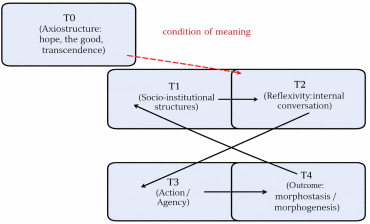
From the perspective of morphodynamics, this entails the necessity of extending the classical T1-T4 model by a deep axiological layer, which may be designated as T0 - the axiostructure. This is not an additional phase of the process but an ontological condition of possibility of reflexivity and action, without which the morphogenetic cycle itself could not be initiated. T0 does not constitute an empirical level of analysis, nor a further stage of the process, but rather the ontological ground enabling the activation of reflexivity.
In order to conceptualize this dimension, I propose the notion of chrono-hope, understood as a rhythm of meaning rooted not in predictability or adaptation, but in an ontological openness to the future. Whereas the concept of chronostructure refers to the social organization of rhythms of action, chrono-hope points to their grounding in a horizon of meaning that transcends current structural conditions. Inspiration for this formulation is drawn from Ernst Bloch’s ontological conception of hope, which he understood as a category opening the future as a space of the “not-yet .” Chrono-hope differs from expectation in that it is not based on probability, but on meaning.
Chrono-hope does not signify naïve optimism, but rather an axiological rhythm of resistance against meaninglessness and the reduction of agency to adaptive management. It is the capacity to sustain action despite uncertainty and contradictory data, precisely because it is grounded in structures of meaning rather than solely in the existing social order. In this sense, hope is not an addition to reflexivity but one of its ontological conditions .
If hope and transcendence thus constitute conditions of sense-generating agency, a crucial question emerges as to whether contemporary digital culture supports their sustenance or instead contributes to their blockage - a question that frames the subsequent analysis. In this sense, Frankl’s understanding of meaning as an objective situational call may be interpreted as an anthropological analogue of the axiostructure (T0) - not as an additional element of the model, but as its existential grounding.
5. Digital Anthropology and the Erosion of Reflexivity
As demonstrated in the previous section, a condition of sense-generating agency is its grounding in axiological depth (T0). Meanwhile, the dominant forms of digital culture tend to foster types of subjectivity that may weaken these conditions by shifting the emphasis from reflexive self-determination toward adaptive management of action. This raises a fundamental question: what forms of subjectivity are generated by contemporary digital culture, and -within a critical realist perspective - do they foster reflexivity or rather constrain it?
The erosion of the human - world relation becomes particularly evident under conditions of chronic acceleration, resulting from the intensification of social and temporal change. In such conditions, time ceases to function as a space for reflection and increasingly organizes life as a sequence of tasks requiring constant adaptation. As a result, the subject loses resonant agency and comes to function more as a manager of tasks than as an autonomous source of meaning .
The dominant model of subjectivity thus shifts from reflexivity toward performance, suggesting that “today’s human being is a project of the self-exploiting subject who no longer encounters external constraints but is driven by an internalized imperative of optimization .” In this respect, this diagnosis converges with that of Hartmut Rosa, though the emphases differ: Rosa foregrounds the dynamics of acceleration, whereas Han stresses the internal mechanism of self-disciplining optimization.
Yuk Hui approaches this phenomenon from a technical perspective, arguing that recursive algorithmic systems transform contingency into predictability, thereby constraining the possibility of acting otherwise . As Hui demonstrates, the space of unpredictability that conditions the capacity for reflection and the initiation of sense-generating processes gradually disappears . Algorithms do not merely respond to data; they also pre-empt decisions through technical forms of anticipation, thereby narrowing the temporal space available for deliberation .
Luciano Floridi develops this diagnosis from the standpoint of data ontology in The Philosophy of Information, describing the subject as an element of the infosphere functioning as an informational agent. On this basis, the subject ceases to be an external centre of decision-making, and agency assumes an operational and relational form: “We are no longer separated from information; we are immersed in it to the point of becoming informational agents ourselves .”
Nick Couldry and Ulises A. Mejias further demonstrate that data do not constitute a neutral representation of reality but rather function as instruments of power that transform social relations and reconfigure the conditions of subjectivity within a logic of extraction . Against this backdrop, it is worth noting that Tsuo-Yu Cheng - reinterpreting Rosa - shifts the analytical focus toward human-thing-world relations, treating them as a key site where contemporary relational pathologies emerge . Similar conclusions are drawn within digital anthropology, which emphasizes that online environments do not merely mediate social relations but actively co-produce forms of subjectivity and identity practices . Ethnographic research shows that digital subjectivity is shaped in relation to platforms, interfaces, and algorithmic procedures that organize modes of presence, communication, and action in the social world . From the perspective of morphodynamics, however, such configurations of the action environment tend to promote a shift from reflexive self-determination toward reactivity, thereby undermining the maintenance of the internal conversation as a condition of sense-generating agency .
In this account, there emerges a risk of blocking the morphogenetic cycle already at the stage of reflexive mediation (T2), which in turn constrains the possibility of sense-generating action (T3). Within critical realism, this implies that the weakening of reflexivity leads to a reduction of agency and, consequently, to the inhibition of structural transformation. Contemporary social and technological systems do not abolish reflexivity outright; rather, they generate conditions in which reflexivity becomes increasingly dysfunctional from the standpoint of systemic logic. This is not merely a cognitive crisis but an ontological problem: the contraction of the inner space in which meaning could be generated and sustained. Viktor E. Frankl criticizes the reduction of the human being to reactivity, noting that certain therapeutic approaches “deny the human being the capacity to take a definite stand under any circumstances.” He contrasts this with an understanding of the person as capable of self-determination vis-à-vis circumstances - an insight that closely resonates with the present diagnosis of a blockage at T2 .
Such suspended agency finds confirmation in empirical data. Findings from the Youth 4.0 report indicate that a substantial proportion of young respondents experience difficulties in articulating the meaning of their actions, more frequently declaring states of disorientation than clearly defined sense-generating projects. From a morphodynamic perspective, these findings may be interpreted as an empirical manifestation of a blockage at the level of T2 - reflexive mediation that fails to lead to sense-generating action.
In this context, morphodynamics - supplemented by the dimension of transcendence - may serve as a tool for diagnosing an anthropological crisis. It enables recognition of the fact that contemporary social and technological rhythms are not neutral but generate specific forms of subjectivity that facilitate adaptation to systemic logic while not necessarily enabling sense-generating transformation. In the subsequent section, I therefore develop the proposal of a morphodynamics of transcendence, which allows for the identification of such blockages and for specifying the conditions of their overcoming.
6. Morphodynamics of Transcendence: A Model Proposal
In light of the diagnosis of declining reflexivity and the erosion of deep meaning in digital society, it becomes necessary not only to protect but also to reconstruct the conditions of sense-generating action. The existing morphogenetic model (T1-T4), as well as its development in the form of morphodynamics, effectively captures the sequence of social change; however, it does not explicitly account for the axiological point of reference that enables the very initiation of reflexivity. As demonstrated above, the erosion of depth of meaning may prevent the activation of the internal conversation (T2), thereby blocking the entire transformative sequence.
I therefore propose extending morphodynamics by an additional ontological level, designated as T0 - the axiostructure. This does not constitute another phase of the sequence, but rather an ontological condition of the entire cycle - a meta-level that renders reflexivity and action themselves possible. T0 denotes the grounding of the subject in a horizon of the good, hope, or truth, understood not in a doctrinal sense but as real, generative structures of meaning . From the standpoint of critical realism, this level may be interpreted as analogous to the domain of generative mechanisms - empirically unobservable yet real and causally efficacious . The concept of T0, together with the notion of chrono-hope, develops earlier proposals of morphodynamics by demonstrating that a full cycle of agency requires not only structural and temporal conditions, but also an ontological grounding of meaning.
In this sense, the proposal of the axiostructure (T0) remains consistent with more recent reconstructions of critical realism, which emphasize that the axiological and ethical dimension is not an addition to ontology but one of its constitutive layers. As Stochmal observes, morality and values function as real generative mechanisms, even when they are not explicitly recognized by social actors .
Extended Scheme
1) T0 - axiostructure (ontological point of reference, e.g. the good, hope, meaning, transcendence),
2) T1 - socio-institutional structures,
3) T2 - individual reflexivity (internal conversation),
4) T3 - action (agency),
5) T4 - outcome: morphostasis or morphogenesis.
A novel component of this model is the concept of chrono-hope, understood as a rhythm of action grounded not in predictability or systemic compulsion, but in an ontological openness to the future as a field of meaning. Whereas chronostructure referred to the social organization of rhythms of action, chrono-hope indicates their grounding in a horizon of the future understood as the “not-yet.” Accordingly, hope is not an emotional supplement to reflexivity, but one of its ontological conditions: without reference to enduring goods and meanings, reflexivity risks being reduced to adaptive “coping” with the pressures of reality .
Table 1. Types of agency in the model of the morphodynamics of transcendence (interpretive heuristic).

Type of Agency

Characteristics

Ontological / Structural Grounding

Trajectory of Change

Adaptive

Reactive; lacking reference to values

T1 → T2/T3

Morphostasis

Instrumental

Goal-oriented, but not necessarily sense-generating

T1–T3

Instrumental morphogenesis

Emancipatory

Reflexive; grounded in values

T0–T4

Morphogenesis of meaning

Blocked (Suspended)

Reflexivity without transition to action; impasse at T2

T0–T2

Potential stagnation

Transcending

Grounded in hope; action undertaken without guarantees

T0–T4 (under tension)

Axiological morphogenesis

The proposed typology of agency has a heuristic and interpretive character; it may be employed in qualitative analyses of biographical narratives as a tool for reconstructing trajectories of meaning and identifying blockages of reflexivity. This model enables not only the interpretation of blockages and fractures of contemporary agency, but also opens a space for an engaged sociology - one that does not merely interpret the world, but participates in its transformation .
The morphodynamics of transcendence proposed here does not compete with Archer’s classical model, but rather deepens it by demonstrating that agency itself requires a foundation - something that cannot be reduced either to institutions or to information . In this way, the morphodynamics of transcendence opens the path to conceptualizing hope not as an emotion, but as an ontological condition of sense-generating action, a claim that will be further developed in the conclusion.
Source: Author’s own elaboration drawing on Archer (Realist Social Theory…; Being Human…) and Bhaskar (A Realist Theory…).

Download: Download full-size image

Figure 1. Morphodynamics of Transcendence: An Extended Model of Agency (T0-T4).
The diagram illustrates an extension of the classical morphogenetic cycle through the inclusion of the axiostructural level (T0), conceptualized as an ontological condition enabling reflexivity and sense-generating agency.
7. Conclusion: Hope as an Epistemological and Ontological Necessity
Throughout this article, an attempt has been made to update and deepen the morphogenetic model within the framework of critical realism by taking into account contemporary digital, axiological, and anthropological conditions. The contribution of this article consists in extending the morphogenetic model by introducing T0 (the axiostructure), developing the concept of chrono-hope, proposing a typology of agency, and applying these analytical frameworks to the diagnosis of an anthropological crisis of reflexivity in digital culture. The proposed morphodynamics of transcendence builds upon earlier theoretical contributions and is here complemented by an explicitly axiological and transcendent dimension.
Against this background, hope - understood not as an emotion but as an ontological structure enabling action in the face of uncertainty - emerges as a key category. As chrono-hope, it organizes the individual’s relation to the future in a manner alternative to technical and systemic rhythms. Archer emphasizes that without hope, reflexivity degenerates into coping - a purely adaptive processing of reality . Bloch adds that “hope is an ontological category that opens the future as a space of the not-yet .”
From the perspective of critical realism, hope is not an illusion; on the contrary, it constitutes a response of the subject to real - though often invisible - mechanisms of the good and of transformative possibility. In the spirit of emancipatory philosophy, Bhaskar wrote: “If we abandon the possibility of emancipation, we also abandon the very meaning of the social sciences as a transformative practice .”
The proposed T0-T4 framework, incorporating both the axiostructure and the rhythm of hope, demonstrates that any analysis of social change must take into account not only structure and agency, but also the question of meaning: Why act? What makes action worth the effort? Is action in defence of meaning - rather than merely of interest - possible? As Levinas argues, the relation to the Other constitutes a primordial source of meaning , while Taylor reminds us that identity is always constituted within horizons of value .
In this sense, the morphodynamics of transcendence proposed here aligns with a broader current of critical revisions of resonance theory, which - as Cheng shows - seek deeper, structural conditions of the possibility of sense-generating being-in-the-world . On this basis, the morphodynamics of transcendence does not merely interpret the world but - in accordance with the postulate of critical realism - participates in its transformation. It thus constitutes both a research and an ethical proposal: a tool for diagnosing and designing reflexive action in a world in which what is disappearing is not knowledge as such, but the belief that action still matters.
From this perspective, empirical reports such as Youth 4.0 may be read not only descriptively but also diagnostically - as indicators of rhythmic and axiological blockages of agency. These diagnoses resonate with the reflections of Zygmunt Bauman, who argued that modern sociology cannot be axiologically neutral, since morality itself constitutes a fundamental dimension of human being-in-the-world, even if it remains structurally fragile and deprived of a stable ontological grounding .
Possible Directions for Further Research (Qualitative Approaches)
Operationalizing the axiostructure in biographical research - How does T0 manifest itself in life narratives?
Chrono-hope as a matrix of education and formation - How can rhythms be taught that ground action in meaning rather than in reaction?
Blocked agency as a category for describing the digital generation - Does contemporary youth remain at T2 without transitioning to T3?
Destructive morphodynamics - How can forms of transformation oriented toward axiological disintegration be diagnosed and counteracted?
In this context, Frankl’s call to responsibility acquires particular force: “If each of us does not give everything he can, the situation in the world - already disastrous - will become even worse .” In this way, morphodynamics - previously developed as a model of structural, reflexive, and temporal change - is here complemented by an axiological and transcendent dimension, indispensable for understanding agency under conditions of a profound crisis of meaning. In this respect, the proposed framework is consistent with an understanding of sociology as a reflexive and critical practice that attends to the ontological and axiological conditions of agency, while retaining its explanatory orientation toward the structures and mechanisms that render meaningful action possible.
Abbreviations

CR

Critical Realism

T0–T4

Morphogenetic Stages

Author Contributions
Marek Wos is the sole author. The author read and approved the final manuscript.
Conflicts of Interest
The author declares no conflicts of interest.
References
[1] Henri Lefebvre, Rhythmanalysis: Space, Time and Everyday Life, trans. Stuart Elden and Gerald Moore, London–New York: Continuum, 2004.
[2] Hartmut Rosa, Resonance: A Sociology of Our Relationship to the World, trans. James C. Wagner, Cambridge: Polity Press, 2019, p. 150.
[3] Byung-Chul Han, The Burnout Society, trans. Erik Butler, Stanford, CA: Stanford University Press, 2015, (B.-Ch. Han, Społeczeństwo zmęczenia i inne eseje, trans. Rafał Pokrywka; the essay “Społeczeństwo zmęczenia” trans. by Michał Sutowski; translation revised by Rafał Pokrywka, Warsaw: Krytyka Polityczna Publishing House, 2022).
[4] Yuk Hui, Recursivity and Contingency, Lanham, MD: Rowman & Littlefield International, 2019.
[5] Luciano Floridi, The Philosophy of Information, Oxford: Oxford University Press, 2011.
[6] Nick Couldry and Ulises A. Mejias, The Costs of Connection: How Data Is Colonizing Human Life and Appropriating It for Capitalism, Stanford, CA: Stanford University Press, 2019.
[7] Margaret S. Archer, Realist Social Theory: The Morphogenetic Approach, Cambridge: Cambridge University Press, 1995.
[8] Margaret S. Archer, Being Human: The Problem of Agency, Cambridge: Cambridge University Press, 2000.
[9] Tsuo-Yu Cheng, “On the Quadrants of the Thing–World Relations,” The Journal of Chinese Sociology 10 (2023):
[10] Marek Wos, “Sense of Life in the Post-Industrial Civilizational Crisis,” Polish Journal of Critical Realism 5 (2024) no. 2.
[11] Roy Bhaskar, A Realist Theory of Science, Leeds: Leeds Books, 1975.
[12] Douglas V. Porpora, Reconstructing Sociology: The Critical Realist Approach, Cambridge: Cambridge University Press, 2015, pp. 23-28.
[13] Marek Wos, “Structure, Agency, and Social Change: The Significance of Critical Realism,” Polish Journal of Critical Realism 3 (2024) no. 6, pp. 131-134.
[14] Margaret S. Archer, Structure, Agency and the Internal Conversation, Cambridge: Cambridge University Press, 2003, p. 215.
[15] Viktor E. Frankl, Man’s Search for Meaning, trans. Ilse Lasch, Boston: Beacon Press, 2006 (V. E. Frankl, Człowiek w poszukiwaniu sensu, Warszawa 2014).
[16] Robert Spaemann, Persons: The Difference between ‘Someone’ and ‘Something’, trans. Oliver O’Donovan, Oxford: Oxford University Press, 2006, pp. 49-53 (R. Spaemann, To, co naturalne, tłum. K. Michalski, Warszawa 2000).
[17] Douglas V. Porpora, “Some Reservations About Flourishing.” In Morphogenesis and Human Flourshing, editor Margaret S. Archer. Cham: Springer, 2017, pp 47-49, 55-56.
[18] Charles Taylor, Sources of the Self: The Making of the Modern Identity, Cambridge, MA: Harvard University Press, 1989.
[19] Paul Ricoeur, “Narrative Identity,” Philosophy Today 35 (1991), no. 1, p. 30-35.
[20] Krzysztof Wielecki, Culture versus Mass Culture, Warsaw: Narodowe Centrum Kultury, 2024, pp. 626-627.
[21] Roy Bhaskar, The Possibility of Naturalism: A Philosophical Critique of the Contemporary Human Sciences, 3rd ed., London: Routledge, 1998, pp. 39-41.
[22] Margaret S. Archer, Transcendence: Critical Realism and God, London–New York: Routledge, 2012.
[23] Douglas V. Porpora, “The Human Project,” in Margaret S. Archer, Andrew Collier, and Douglas V. Porpora (eds.), Transcendence: Critical Realism and God, London–New York: Routledge, 2004.
[24] Artur Wysocki, “The Transcendence of the Person in Forgiveness: The Perspective of Relational Sociology,” Seminare: Scholarly Explorations 38 (2017), no. 4, pp. 83-93.
[25] Roy Bhaskar, Scientific Realism and Human Emancipation, London: Verso, 1986, pp. 120-125.
[26] Roy Bhaskar, Dialectic: The Pulse of Freedom, London: Verso, 1993, pp. 185-190.
[27] Ernst Bloch, Das Prinzip Hoffnung, Frankfurt am Main, 1959.
[28] Daniel Miller and Heather A. Horst (eds.), Digital Anthropology, London–New York: Berg, 2012, pp. 1-6.
[29] Tom Boellstorff, Coming of Age in Second Life: An Anthropologist Explores the Virtually Human, Princeton, NJ: Princeton University Press, 2008.
[30] Sarah Pink, Heather Horst, John Postill, Larne Hjorth, Tania Lewis, and Jo Tacchi, Digital Ethnography: Principles and Practice, London: Sage, 2016.
[31] For a more detailed discussion on this topic, see: Waldemar Urbanik, Portrait of Contemporary Polish Youth in the Light of the Youth 4.0 Project – Vol. II, Szczecin: „Pedagogium” Wydawnictwo OR TWP w Szczecinie, 2023.
[32] Małgorzata Stochmal, “Using Critical Realism to Analyse Big Data: Ontic, Epistemic, and Ethical Assumptions,” DOT.PL 1 (2025), pp. 11-12.
[33] Roy Bhaskar, Reflections on Meta-Reality, London: Sage, 2002, p. 37.
[34] Margaret S. Archer, The Reflexive Imperative in Late Modernity, Cambridge: Cambridge University Press, 2012, pp. 210-212.
[35] Emmanuel Levinas, Totality and Infinity: An Essay on Exteriority, trans. Alphonso Lingis, Pittsburgh: Duquesne University Press, 1969, pp. 43-45.
[36] Nina Krasko, “The Sociology of Zygmunt Bauman: Society and Values,” Culture and Society (Kultura i Społeczeństwo) 2005, no. 3, pp. 68-71.
Cite This Article
  • APA Style

    Wos, M. (2026). The Morphodynamics of Transcendence as a Condition of Meaning-generating Agency: An Extension of the Morphogenetic Model in Critical Realism. International Journal of Science, Technology and Society, 14(1), 12-20. https://doi.org/10.11648/j.ijsts.20261401.12

    Copy | Download

    ACS Style

    Wos, M. The Morphodynamics of Transcendence as a Condition of Meaning-generating Agency: An Extension of the Morphogenetic Model in Critical Realism. Int. J. Sci. Technol. Soc. 2026, 14(1), 12-20. doi: 10.11648/j.ijsts.20261401.12

    Copy | Download

    AMA Style

    Wos M. The Morphodynamics of Transcendence as a Condition of Meaning-generating Agency: An Extension of the Morphogenetic Model in Critical Realism. Int J Sci Technol Soc. 2026;14(1):12-20. doi: 10.11648/j.ijsts.20261401.12

    Copy | Download

  • @article{10.11648/j.ijsts.20261401.12,
      author = {Marek Wos},
      title = {The Morphodynamics of Transcendence as a Condition of Meaning-generating Agency: An Extension of the Morphogenetic Model in Critical Realism},
      journal = {International Journal of Science, Technology and Society},
      volume = {14},
      number = {1},
      pages = {12-20},
      doi = {10.11648/j.ijsts.20261401.12},
      url = {https://doi.org/10.11648/j.ijsts.20261401.12},
      eprint = {https://article.sciencepublishinggroup.com/pdf/10.11648.j.ijsts.20261401.12},
      abstract = {Contemporary societies increasingly operate within rhythmic regimes dominated by technical acceleration, algorithmic anticipation, and systemic optimization. These transformations fundamentally affect the conditions under which human agency, reflexivity, and meaning-generation remain possible. Drawing on the framework of critical realism, this article argues that the current crisis of meaning cannot be adequately explained solely through relational, cultural, or psychological diagnoses. Instead, it requires a reconstruction of the ontological conditions of agency itself. Building upon Margaret S. Archer’s morphogenetic model (T1-T4), the article introduces the concept of morphodynamics, extended by an axiological level designated as T0 (axiostructure). This level is not an additional phase of social change but an ontological condition of possibility for reflexivity and sense-generating action. The article further develops the notion of chrono-hope, understood as a rhythm of action grounded in ontological openness to the future rather than in technical predictability or adaptive coping. By integrating insights from critical realism, digital anthropology, and contemporary diagnoses of acceleration and fatigue, the article proposes a typology of agency that distinguishes adaptive, instrumental, emancipatory, blocked, and transcending forms of action. Empirical references to contemporary youth research are interpreted diagnostically as manifestations of suspended agency at the level of reflexive mediation (T2). The article concludes that hope, understood not as emotion but as an ontological structure, constitutes a necessary condition of meaning-generating agency in late modern digital societies. In this sense, the morphodynamics of transcendence provides an analytical framework for diagnosing the conditions and limits of agency in the contemporary crisis of meaning.},
     year = {2026}
    }
    

    Copy | Download

  • TY  - JOUR
    T1  - The Morphodynamics of Transcendence as a Condition of Meaning-generating Agency: An Extension of the Morphogenetic Model in Critical Realism
    AU  - Marek Wos
    Y1  - 2026/02/11
    PY  - 2026
    N1  - https://doi.org/10.11648/j.ijsts.20261401.12
    DO  - 10.11648/j.ijsts.20261401.12
    T2  - International Journal of Science, Technology and Society
    JF  - International Journal of Science, Technology and Society
    JO  - International Journal of Science, Technology and Society
    SP  - 12
    EP  - 20
    PB  - Science Publishing Group
    SN  - 2330-7420
    UR  - https://doi.org/10.11648/j.ijsts.20261401.12
    AB  - Contemporary societies increasingly operate within rhythmic regimes dominated by technical acceleration, algorithmic anticipation, and systemic optimization. These transformations fundamentally affect the conditions under which human agency, reflexivity, and meaning-generation remain possible. Drawing on the framework of critical realism, this article argues that the current crisis of meaning cannot be adequately explained solely through relational, cultural, or psychological diagnoses. Instead, it requires a reconstruction of the ontological conditions of agency itself. Building upon Margaret S. Archer’s morphogenetic model (T1-T4), the article introduces the concept of morphodynamics, extended by an axiological level designated as T0 (axiostructure). This level is not an additional phase of social change but an ontological condition of possibility for reflexivity and sense-generating action. The article further develops the notion of chrono-hope, understood as a rhythm of action grounded in ontological openness to the future rather than in technical predictability or adaptive coping. By integrating insights from critical realism, digital anthropology, and contemporary diagnoses of acceleration and fatigue, the article proposes a typology of agency that distinguishes adaptive, instrumental, emancipatory, blocked, and transcending forms of action. Empirical references to contemporary youth research are interpreted diagnostically as manifestations of suspended agency at the level of reflexive mediation (T2). The article concludes that hope, understood not as emotion but as an ontological structure, constitutes a necessary condition of meaning-generating agency in late modern digital societies. In this sense, the morphodynamics of transcendence provides an analytical framework for diagnosing the conditions and limits of agency in the contemporary crisis of meaning.
    VL  - 14
    IS  - 1
    ER  - 

    Copy | Download

Author Information
  • Faculty of Social Sciences, Academy of Applied Sciences TWP, Szczecin, Poland

    Biography: Marek Wos is an adjunct professor at the Akademia Nauk Stosowanych Towarzystwa Wiedzy Powszechnej (TWP) in Szczecin, Poland. He is a former long-term school principal and an expert in the professional advancement of teachers. His academic and professional interests focus on education, subjectivity, meaning-making processes, and critical realism, with particular attention to the relationship between structure, agency, and reflexivity in contemporary societies. He is the author of several books, a co-author of multiple scholarly monographs, and the author of several dozen academic articles published in peer-reviewed journals. His current research explores the morphodynamics of agency, transcendence, and hope under conditions of digital acceleration and socio-cultural transformation.